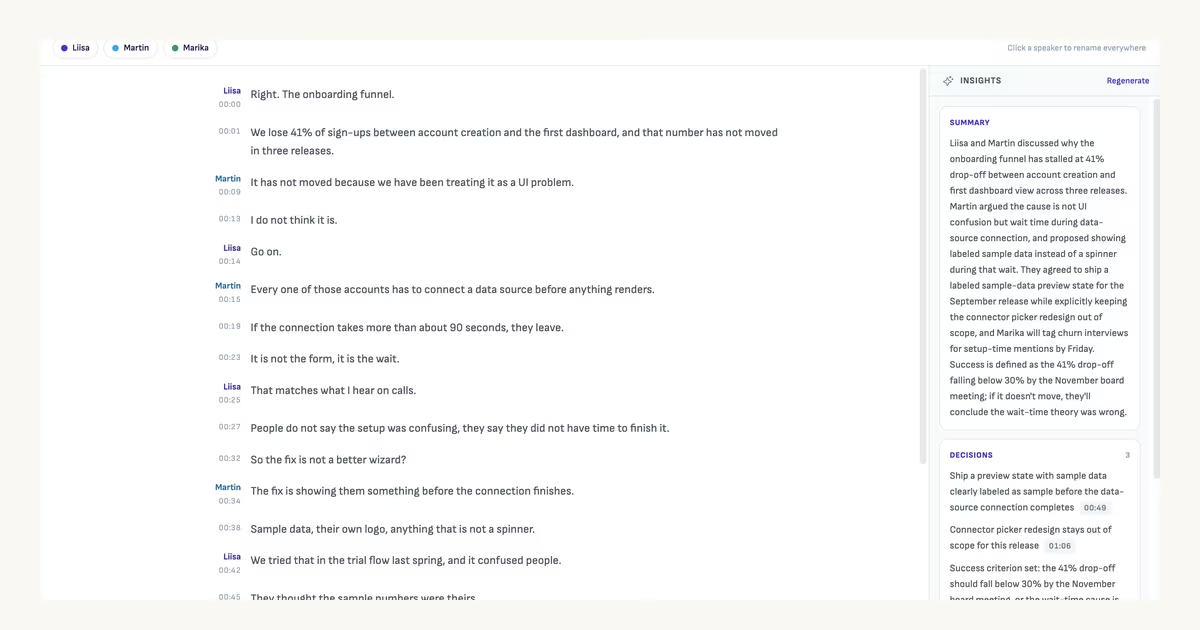
Transcription stopped being the hard part somewhere around 2023. It is cheap, it is fast, and for a clean recording it is close enough to perfect that arguing about accuracy is mostly nostalgia.
And yet the follow-up email still does not go out. The handout still does not get written. Trainers still stand in front of a group, promise a summary, and quietly know that what will actually arrive is the slide deck, because the deck already exists.
That gap is worth looking at honestly, because it is not a transcription problem and no amount of better transcription will close it.
What a transcript actually is
A two-hour session produces somewhere around eighteen thousand words. Every false start is in there. Every time someone said "sorry, go on" is in there. The moment where you explained the same idea three ways because the first two did not land takes up four hundred words and reads like repetition rather than teaching.
A transcript is a recording in a different medium. It is not shorter, it is not organised, and it is not addressed to anyone. Sending one to a group who attended the session is close to insulting, because it hands them the raw material and keeps the part that required judgement.
The handout is a different document with a different job. It says: here are the three things that mattered, here is the example that worked, here is what to do before we meet again. Getting from one to the other is editorial work, and editorial work is what nobody has time for on a Thursday when the next group is booked for Monday.
The part that is genuinely hard
Deciding what to leave out.
The transcript contains everything, which means it contains no signal about what was important. You were in the room, so you know: the question at 00:47 was the one that changed the mood, the exercise in the second hour worked better than the one you had planned, and half the group was confused about the same thing in a way you did not expect.
That knowledge lives in your head for about two days and then fades into a general impression that the session went fine. Which is precisely why the handout gets written badly or not at all. By the time there is a free afternoon, the specific memories are gone and you are reconstructing a session from a transcript like a stranger would.
So the useful tool is not one that turns audio into text. It is one that keeps the material and your judgement in the same place, while your judgement is still fresh.
What that looks like in practice
Put the recording in the same folder as the lesson plan. Transcribe it there, so the transcript has speaker labels and a timestamp on every line and reads like minutes rather than a wall.
Then, while you still remember, say what mattered. Not in a note to yourself, but as an instruction: the group struggled with the second exercise, the question about edge cases came up twice, use the worked example from the second hour. An agent that can read the plan and the transcript in that folder can draft the handout from exactly that, and you edit rather than reconstruct.
The exercises for next time come out of the same material, and they are better than the ones you would have invented, because they are built from what the group actually got wrong rather than what you assumed they would.
None of this is magic. It is the same editorial work, done at the moment when you still have the context to do it well, with the raw material one click away instead of buried in a tool you have to go and find.
The part worth being careful about
A recording of a workshop is audio of people who did not necessarily expect to be quoted. That deserves more thought than it usually gets.
In Ritemark the choice is explicit, and the two options are genuinely different. On a Mac with Apple silicon, transcription runs on your own machine and the audio never leaves it, which is the right answer for a sensitive session. It will not separate speakers, so a multi-voice workshop comes back as one continuous transcript. The other option, ElevenLabs, does separate speakers and costs about a cent a minute, and it works by uploading your audio under your own key.
The app tells you which one is about to happen, with the cost, before it starts. That is deliberate: uploading a client session should be a decision, not a default.
Tell people you are recording. Then pick the engine that matches what you told them.
Why this matters more than it sounds
The follow-up is where a training session either becomes a change in how people work or evaporates into a pleasant afternoon. Everyone knows this. The reason it gets skipped is not that trainers are lazy, it is that the work sits in the worst possible slot: after the energy of the session is gone, before the next one demands attention, and at a moment when the material is inconveniently large and your memory of it is inconveniently short.
Making that hour cheaper is not a small feature. It is the difference between a group that remembers three things and a group that remembers that the coffee was good.