The documentation maintenance trap
Technical writers know the feeling. A new release ships. The changelog lists 30 changes. Twelve of them affect the API docs. Five affect the getting started guide. Two require entirely new pages. And you need to find every place in the existing docs where the old behavior is described, update it, make sure nothing contradicts itself, and do it before the release announcement goes out.
Most writers work in a docs platform like GitBook, Docusaurus, or Confluence. The content is scattered across dozens of pages. Finding every reference to a changed endpoint means searching through hundreds of files. And when you ask an AI for help, you paste in one page at a time because the AI tool can't see the rest of the docs.
An AI agent that reads your whole docs folder
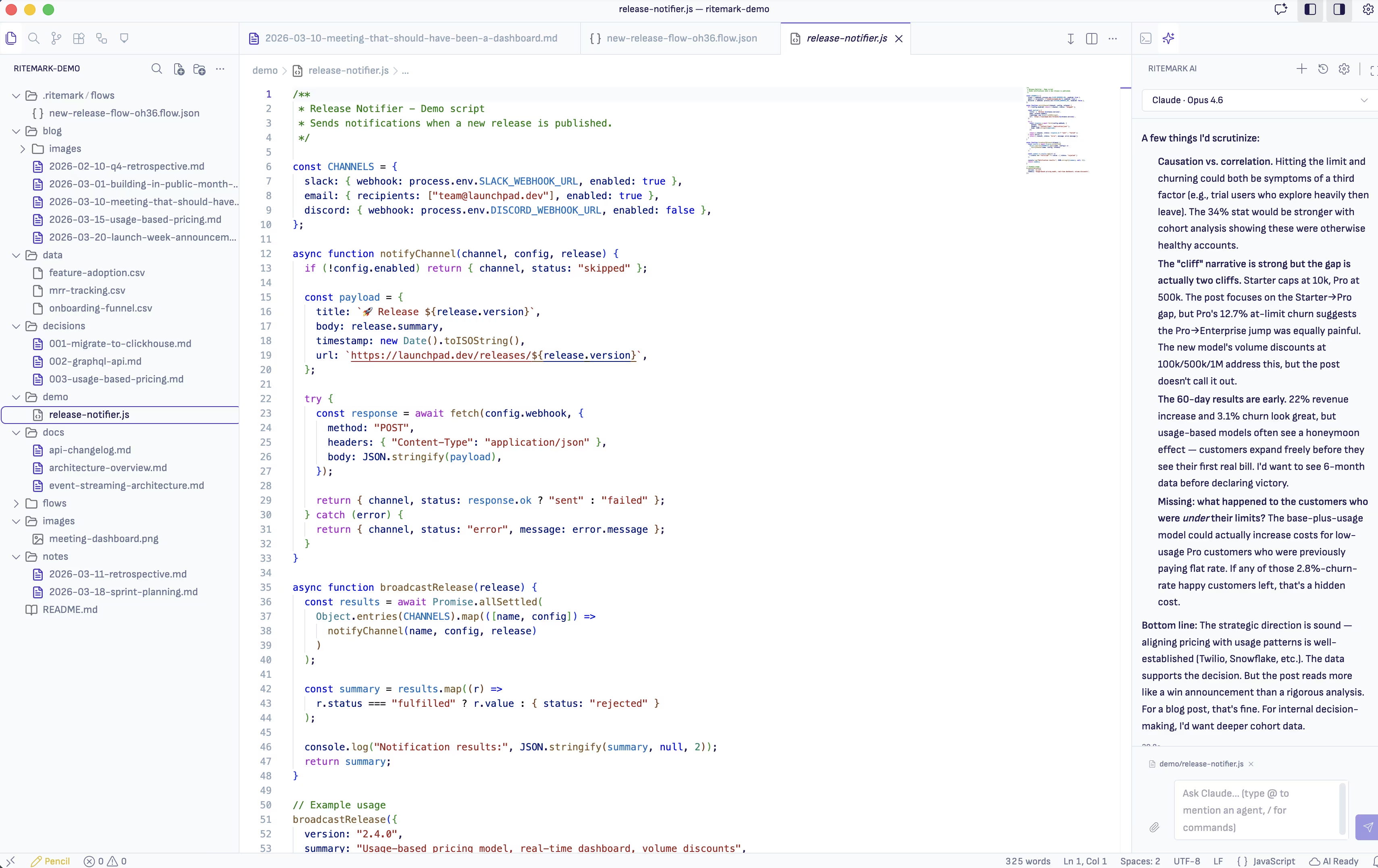
Ritemark is a markdown editor with an AI agent built into the workspace. Your documentation files live in a folder on your machine. The agent can read every file in that folder.
Open your API docs project in Ritemark. You have 40 endpoint pages, a getting started guide, authentication docs, and a changelog. Open the AI sidebar, choose Claude Code, Codex or OpenCode, and tell it: "Read the changelog for v2.5 and identify every documentation page that needs updating."
The agent scans the changelog, cross-references it against your existing docs, and gives you a list. Not a guess based on one file you pasted. An actual cross-reference of your entire documentation set.
Updating docs after a release
Here's what the workflow looks like when v2.5 ships.
You open the changelog file and the API docs folder in Ritemark. Start the AI agent in the sidebar.
"Read the v2.5 changelog. For each breaking change, find the affected documentation page and draft the update. Keep the existing tone and formatting."
The agent reads the changelog, then reads each affected doc page. It drafts updates that match your existing style because it can see your existing style. Not a generic rewrite, but targeted patches to specific sections.
You review each update in the visual editor. Accept, modify, or reject. The agent did the cross-referencing and drafting. You do the quality control. A job that used to take a full day now takes a morning.
New feature documentation from specs
Product just shipped a feature with a technical spec. You need to turn that into user-facing documentation.
Drop the spec into your docs project folder. Open a new markdown file for the documentation page. Tell the agent: "Read the technical spec for the webhook feature. Write user-facing documentation following the same structure as our existing endpoint docs. Include code examples in Python and JavaScript."
The agent reads the spec, reads two or three existing endpoint pages to understand your documentation patterns, and generates a first draft. It matches your heading structure, your code example style, your explanation patterns. You edit the draft, add nuance the spec doesn't cover, and you have a new docs page that fits seamlessly with the rest.
Consistency checks across the whole doc set
Documentation drift is real. Over months, different writers use different terms for the same concept. Examples fall out of date. Cross-references break.
"Scan all API endpoint pages. List any inconsistencies in how we describe authentication. Flag any code examples that reference the v1 API."
The agent reads every endpoint page, compares terminology and patterns, and reports what it finds. You get a punch list of inconsistencies to fix, not a vague suspicion that something is off.
Markdown docs in git, not a proprietary platform
Your documentation lives as markdown files in a git repository. Version-controlled. Diffable. Reviewable in pull requests. Any CI/CD pipeline can build them into a docs site.
No proprietary platform lock-in. No exported format that loses structure. No "we need to migrate our docs" project every two years. Just markdown files that have been readable since 2004 and will be readable in 2034.
Start writing with Ritemark.
Free and open source.