Open source means the code behind your editor is public, so anyone can read exactly what it does with your files before an AI agent gets anywhere near them. Ritemark, Zettlr, Logseq, Joplin, and MarkText are all fully open source and free, though they split sharply on license terms and how much AI they build in.
Here are the top open source markdown editors, and what each license actually permits.
1. Ritemark
Best for: Writers who want an inspectable, agent-editable markdown editor
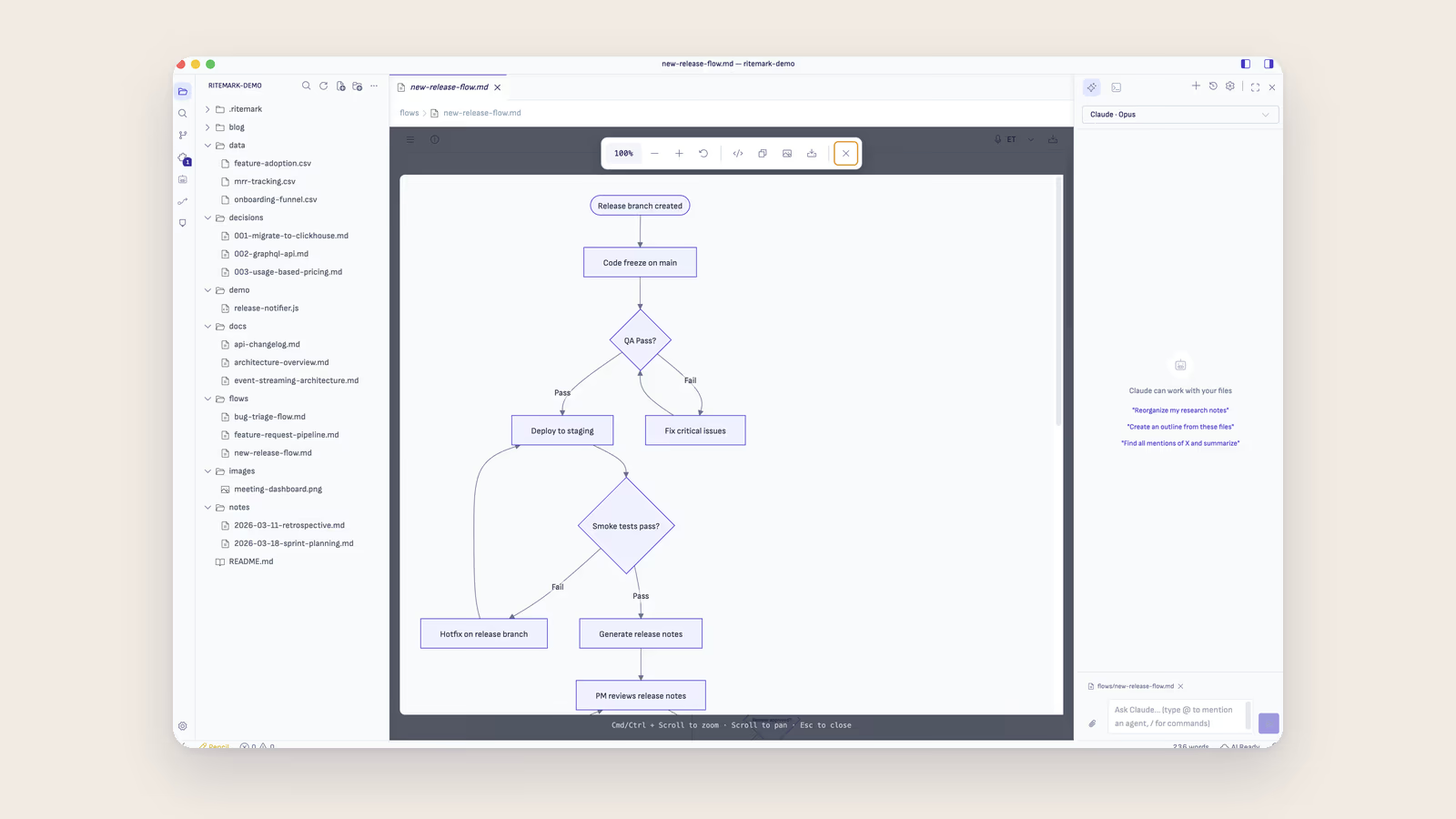
Ritemark is MIT-licensed, built on VS Code, Electron, and xterm.js, with source code readable on GitHub. Its AI sidebar runs Claude Code, Codex or OpenCode directly against your local .md files.
License: MIT, permissive with no copyleft obligation. Platforms: macOS, Windows.
2. Zettlr
Best for: Academic writers who need citations and Pandoc export
Zettlr is GPLv3-licensed and built for research writing, with reference-manager integration, footnotes, LaTeX math, and export to PDF, Word, and HTML through Pandoc. It has no forced cloud sync or telemetry of any kind, and no built-in AI feature.
License: GPL v3, copyleft, modified versions must stay open source. Platforms: Windows, macOS, Linux.
3. Logseq
Best for: Writers who want an outliner with linked daily notes
Logseq is AGPL-3.0-licensed, which is a stronger copyleft than GPL: anyone who runs a modified version as a network service has to publish those modifications too. It has no official AI feature, only community plugins.
License: AGPL-3.0, copyleft, extends to network use. Platforms: Windows, macOS, Linux, iOS, Android.
4. Joplin
Best for: Writers who want free, open source, end-to-end encrypted sync
Joplin is AGPL-3.0-licensed and stores notes in markdown syntax inside its own local database, with plugin support and no built-in AI feature. Encrypted sync works with your own Dropbox, OneDrive, or Nextcloud account at no extra cost.
License: AGPL-3.0-or-later, copyleft, extends to network use. Platforms: Windows, macOS, Linux, iOS, Android.
5. MarkText
Best for: Writers who want a simple, distraction-free WYSIWYG markdown editor
MarkText is MIT-licensed and renders markdown live in a single clean pane, with no plugin system and no AI feature. Worth noting: per its GitHub release and issue history, the project went quiet after its 0.17.1 release in 2022, and maintenance only resumed in May 2026, so check the current release activity before relying on it for daily work.
License: MIT, permissive with no copyleft obligation. Platforms: Windows, macOS, Linux.
Comparison Table
| Tool | License | AI Features | Platforms | Price |
|---|---|---|---|---|
| Ritemark | MIT | Claude Code, Codex, OpenCode in the AI sidebar | macOS, Windows | Free + your AI plan or API keys |
| Zettlr | GPL v3 | None built in | Windows, macOS, Linux | Free |
| Logseq | AGPL-3.0 | Community plugins only | Windows, macOS, Linux, iOS, Android | Free (Sync $5/mo) |
| Joplin | AGPL-3.0-or-later | None built in | Windows, macOS, Linux, iOS, Android | Free |
| MarkText | MIT | None | Windows, macOS, Linux | Free |
How to Choose
If you want an AI agent editing your markdown files directly, with the underlying editor itself fully inspectable, Ritemark is the only option built around that combination. If you write academic papers with citations, Zettlr's Pandoc export handles that better than any general-purpose editor here. If your notes are daily and outline-shaped, Logseq fits, and if free encrypted sync matters most, Joplin covers it. MarkText is the simplest choice for plain distraction-free editing, with the caveat that its maintenance history has gaps.
License terms matter too: MIT (Ritemark, MarkText) lets you use or modify the code with almost no restriction, GPL (Zettlr) requires any modified version you distribute to stay open, and AGPL (Logseq, Joplin) extends that requirement to running a modified version as a network service.
For a look at how these compare on privacy specifically, see how to keep your notes private while using AI writing tools. For apps that skip the account requirement entirely, see the best free local-first writing app list.
Frequently Asked Questions
Is Ritemark really open source?
Yes. It's MIT-licensed and the source code is public on GitHub, built on VS Code, Electron, and xterm.js.
Is Zettlr open source?
Yes, under GPL v3. Zettlr also has no forced cloud sync and no telemetry, so everything stays on your machine unless you export it.
What does AGPL mean for Logseq and Joplin?
AGPL is a copyleft license like GPL, but it also covers running the software as a network service. If someone modifies Logseq or Joplin and offers it as a hosted product, they're required to publish those modifications too.
Is MarkText still maintained?
Yes, as of 2026, though with a gap worth knowing about. Development went quiet after the 0.17.1 release in 2022, and the original maintainer resumed active development in May 2026.
Does any of these editors have built-in AI?
Only Ritemark. Its AI sidebar runs Claude Code, Codex or OpenCode against your files directly, on your own AI plan or keys. Zettlr, Joplin, and MarkText have no AI feature at all, and Logseq's AI support comes only from community plugins.
Do I need to pay for any of these?
No. All five are free to use. Ritemark's AI is the exception: it runs on your own paid Claude plan, your ChatGPT account, or your own API keys. Logseq's only paid option is its optional Sync service at $5 a month; everything else, including the core apps and all local editing, costs nothing.
Which open source markdown editor works on mobile?
Logseq and Joplin both have iOS and Android apps. Ritemark, Zettlr, and MarkText are desktop-only, covering macOS, Windows, and (for Zettlr and MarkText) Linux.
Can I read the source code before trusting an editor with my files?
Yes, for all five. That's what "open source" means here specifically: the full codebase for each is public on GitHub, so you (or anyone) can verify what it does with your files before an AI agent starts editing them.
Which license lets me modify the code most freely?
MIT, which Ritemark and MarkText use. It has almost no restrictions on reuse or modification. GPL and AGPL (Zettlr, Logseq, Joplin) require that modified versions you distribute or host stay open source too.
Start writing with Ritemark.
Free and open source.