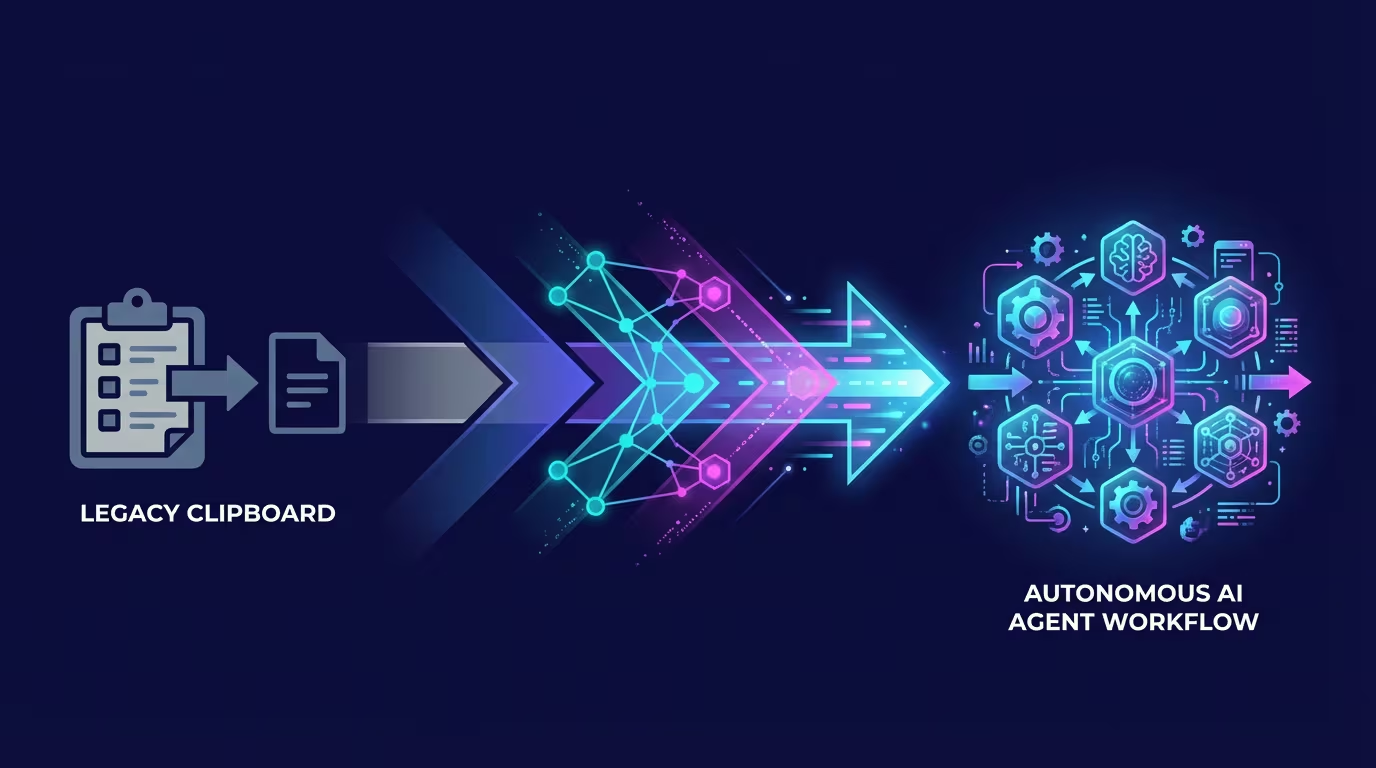
The best AI writing workflow in 2026 is not copy-paste — it's an AI agent with direct file access. Copy-pasting between ChatGPT and your documents is the single biggest focus killer in a modern knowledge worker's day. The fix is a writing environment where the AI reads and edits your files directly, without you acting as the courier.
We've written before about why copy-paste workflows are broken. Today, let's trace the full arc of how AI writing workflows have evolved — and why the gap between Phase 2 and Phase 4 represents roughly 2.5 work weeks of lost productivity per year.
Why This Matters More Than You Think
The scale here is easy to underestimate. According to McKinsey's 2024 State of AI report, approximately 40% of all work-related AI usage involves writing tasks — drafting documents, editing text, summarizing content, translating between languages. That's the single largest category of AI use at work. Over 800 million users engage with ChatGPT weekly, and the majority of them are following the same awkward ritual: open browser, write a prompt, copy the output, switch back to the document, paste, adjust, repeat.
Research from the University of California, Irvine found it takes an average of 23 minutes and 15 seconds to fully regain focus after a significant interruption. A study by Qatalog and GitLab found that knowledge workers toggle between applications approximately 1,200 times per day and lose around 9% of their workday — equivalent to 2.5 work weeks per year — to tool switching. Every jump to ChatGPT and back is paying that tax in full.
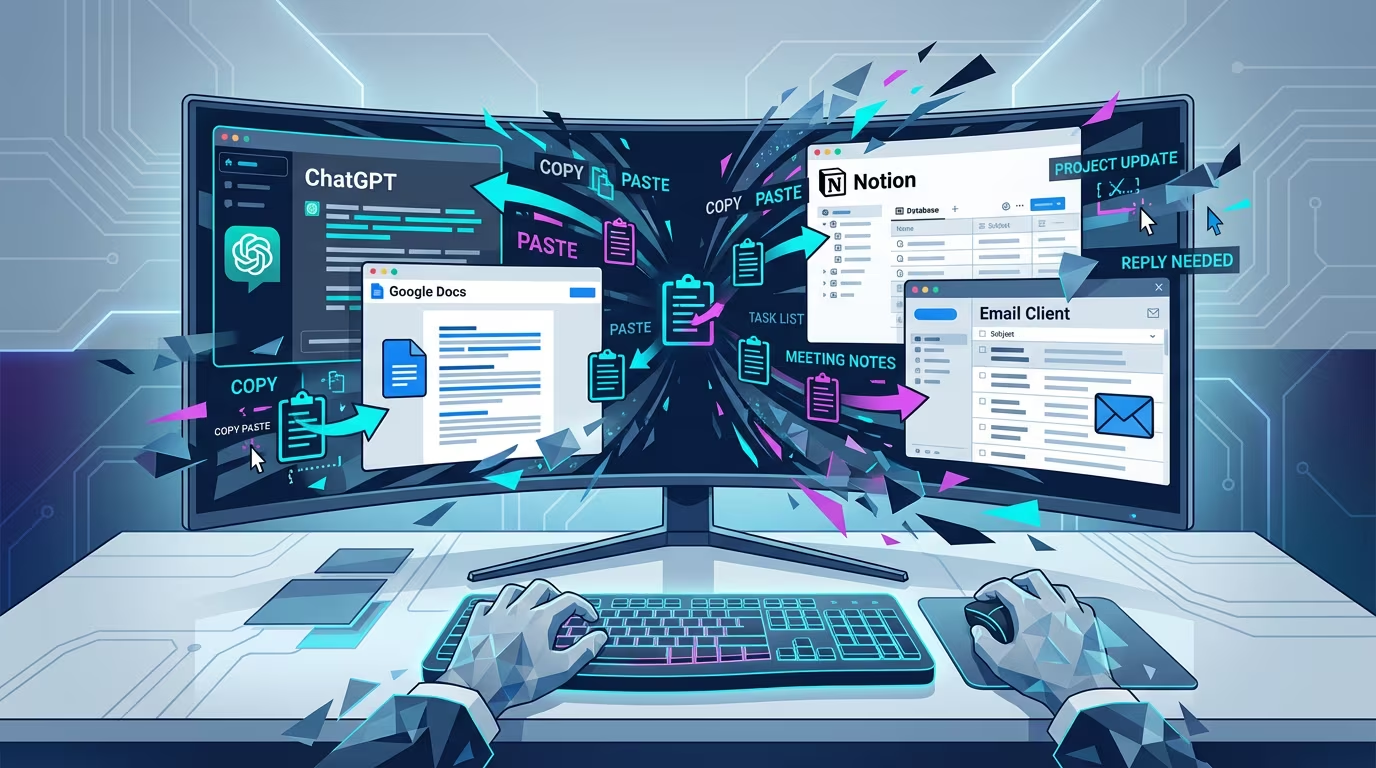 Context switching between apps — the hidden tax on every knowledge worker's day
Phase 1: Manual Writing (Pre-2022)
This is the baseline: a writer and a blank document. The tools were sophisticated word processors and note-taking apps, but the cognitive labor was entirely human. Research, drafting, editing, proofreading — every step required manual effort.
The bottleneck was always the human. A good technical writer might produce 1,000–1,500 polished words per hour under ideal conditions. Most knowledge workers, writing being secondary to their primary role, produced far less. The ceiling felt permanent — until it wasn't.
Phase 2: Copy-Paste with ChatGPT (2022–2024)
ChatGPT's public launch in November 2022 created an immediate behavioral shift. Writers discovered they could generate a draft in seconds, refine it in conversation, then paste the result into their actual document. Productivity gains were real and immediate — but the workflow was always awkward.
Your document lived in one app. Your AI lived in another. You spent your time as a courier between them, manually transferring text back and forth. Context was constantly lost — ChatGPT didn't know what was already in your document, what tone your previous sections used, or what constraints your project had. This is still the dominant workflow in 2026. It's fast compared to writing from scratch, but it's far from the ceiling of what's possible.
Phase 3: Embedded AI Sidebars (2023–Present)
The next evolution brought AI directly into existing tools. Notion AI, Google Docs with Gemini, Microsoft Word with Copilot — all follow the same pattern: an AI panel within your writing environment, trained on the context of your current document.
This was a genuine improvement. The AI could see what you'd written. You didn't need to leave your document. But these tools are fundamentally reactive. You select text and ask the AI to improve it. You highlight a section and ask for a summary. The AI waits for your instruction, acts on what you show it, and hands control back. It's still you doing the orchestration — deciding what to show the AI, what to ask, what to accept. The AI is a capable assistant, but you're managing every interaction manually.
Phase 4: Agentic AI Writing (2025–Present)
This is where the paradigm changes. In Phase 4, the AI doesn't wait for you to show it something — it reads your document autonomously, understands context, takes actions across multiple files, and presents results for your review. You describe an outcome, and the agent figures out the steps.
Developers recognized this pattern first. GitHub Copilot, Claude Code, and Cursor changed how programmers work. A developer can say "refactor this module to use the new API" and the AI reads the relevant files, makes the changes, and shows a diff for review. The developer reviews the output, not the individual steps. Developers became reviewers, not typists. Their productivity multiplied. Writers haven't made this shift yet — but the same approach works just as well for text as it does for code. The agentic knowledge management model is already proving this in practice.
What Agentic Writing Looks Like in Practice
The practical difference is immediate. Instead of copy-pasting a paragraph into ChatGPT and asking "how can I improve this?", you give an instruction to an agent that can see your entire document:
"Translate this post to Estonian, keeping the same tone and structure. Save it as a new file."
"Add an FAQ section to this article based on what the content covers."
"My last three blog posts are in this folder. Read them and write a new post that follows the same style and depth."
In each case, the agent reads the files it needs, performs the work, and produces output for your review. You're not managing individual steps — you're reviewing outcomes. The mental model shifts from "how do I prompt AI to help me write this?" to "what outcome do I want, and what context does the agent need?" This is the same principle behind building a second brain with AI agents — your documents become a living, searchable knowledge system rather than isolated files.
The review step matters. Agentic AI doesn't mean autonomous publishing. You still read what was produced, refine what needs adjusting, and approve before anything is final. But reviewing is faster and less draining than generating from scratch.
Why Writers Haven't Made This Shift Yet
The developer ecosystem built agentic tools for developers first. Claude Code, Copilot, and Cursor assume you're working in a code editor, comfortable in a terminal, familiar with version control. Most writers don't want to run a CLI tool.
This is the gap Ritemark fills. It's a native markdown editor with a built-in AI agent that has direct access to your files. You write in a comfortable, distraction-free environment. The AI agent lives in the sidebar, can read your entire document library, and works across files when you ask it to — no terminal required, no copy-pasting between windows, no context lost in translation. The ability to search local documents with AI is built in from the start. The developer workflow — describe an outcome, review the result — works for writing too. Ritemark brings that workflow to people whose primary tool is language, not code.
The Shift in Mental Model
The most important change between Phase 2 and Phase 4 isn't the technology — it's how you think about your own role.
In Phase 2, you think: "I need to write this paragraph. Let me get some help from AI." You're the writer; AI is a tool you apply to specific moments. In Phase 4, you think: "I need this document to exist. Here's the context, here are the constraints, here's what I want." You're the editor and decision-maker. AI handles generation and mechanical work.
Neither role is passive. Phase 4 requires clear thinking about outcomes, strong editorial judgment, and active curation of what the AI produces. But the time spent on mechanical tasks — switching windows, reformatting pasted text, re-explaining context — collapses dramatically. That's where the 2.5 work weeks per year come back to you.
Ready to Try It?
If you're still copy-pasting between ChatGPT and your documents, you're in Phase 2. Phase 4 is available now.
Download Ritemark — it's free. Install it, open a folder with some of your writing, and try describing an outcome to the AI agent rather than asking it to help with a selection. The difference is immediately obvious.
FAQ
What is an agentic AI writing workflow? An AI agent reads your files directly, takes actions across documents, and returns results for your review — no copy-pasting into a separate chat window required.
How is agentic AI different from Notion AI or Google Docs AI? Embedded tools act only on text you select. Agentic AI reads your entire library unprompted, works across multiple files, and chains multi-step tasks autonomously.
What are the four phases of AI writing workflow evolution? Phase 1: manual writing (pre-2022). Phase 2: copy-paste with ChatGPT (2022–2024). Phase 3: embedded AI sidebars (2023–present). Phase 4: agentic AI with direct file access (2025–present).
How much time do knowledge workers lose to context switching? UC Irvine research puts refocus time at 23+ minutes per interruption. Qatalog and GitLab found workers lose 2.5 work weeks per year to app-switching alone.
Is agentic AI writing fully automated? No. The agent drafts and edits, and you review the result before anything is final. In Ritemark the default mode lets it edit files directly, and you can switch it to ask before each change. Your role shifts from typing to editing — faster, but still requires active judgment.
What percentage of AI usage at work involves writing tasks? McKinsey's 2024 State of AI report puts writing tasks at approximately 40% of all work-related AI usage — the single largest category.
Do I need to know how to code to use agentic AI writing tools? No. Ritemark works entirely through a conversational interface in a native macOS writing environment — no terminal, no CLI, no coding knowledge required.
What are good examples of agentic AI writing tasks? Translating an article and saving it as a new file, adding an FAQ from existing content, rewriting a technical document for executives, or generating a new post in the style of your previous writing.
How does agentic AI handle context across multiple documents? You give the agent permission to read a folder. It then references your writing history, maintains consistent tone and terminology, and treats your library as a unified knowledge base.
Is Ritemark free to use? Yes, the app is free and has no subscription fee. The AI is not: Claude Code needs a paid Claude plan or an Anthropic API key, Codex a paid ChatGPT plan, and OpenCode your own API keys.