When an AI agent becomes part of your daily work, a rate limit stops being a billing detail.
It becomes an operational constraint.
That is the real lesson from the current Claude and Claude Code debate. The story is easy to frame as one company changing limits, one group of power users getting annoyed, or one more round in the Claude-vs-OpenAI cycle. But that misses the bigger point.
If your writing, coding, research, or documentation workflow depends on one model provider's app, one CLI, or one subscription policy, your productivity has a single point of failure.
The answer is not to pick a different single provider and hope the economics stay friendly forever. The answer is to make agent choice part of the workflow itself.
Why this matters now
On May 14, 2026, Axios reported that Anthropic is tightening Claude usage while OpenAI is courting affected users. TechRadar separately reported that Anthropic removed some third-party harnesses, including OpenClaw, from standard Claude subscription limits from April 4, 2026.
Anthropic's own documentation makes the general mechanics clear. Claude API usage is governed by spend limits and rate limits, including requests per minute, input tokens per minute, and output tokens per minute. Anthropic says these limits exist to manage capacity and reduce misuse. It also notes that limits are maximum allowed usage, not guaranteed minimums. The Claude Code help docs also explain that Pro and Max usage is shared across Claude and Claude Code, so coding-agent activity and general Claude activity can draw from the same budget.
None of this is irrational. Frontier AI is expensive. Providers have to manage compute, abuse, fairness, and pricing. Heavy agentic usage can look very different from casual chat usage. A headless coding agent running for hours is not the same cost profile as a few web chat prompts.
But from the user's side, the practical effect is simple: the tool that felt like infrastructure yesterday can become constrained tomorrow.
That is why this is a workflow design problem, not just a pricing story.
Agentic work has different failure modes
A normal chatbot limit is annoying. You wait, switch tabs, or come back later.
An agentic workflow limit is different.
An agent might be halfway through refactoring a codebase. It might be reading a folder, updating files, running tests, and carrying a plan across many turns. It might be helping you write a long article with research, outlines, screenshots, and local notes in context. It might be operating inside a CLI where the work is not one prompt but a sequence of tool calls.
When that workflow hits a limit, the cost is not only the next message. The cost is interruption:
- the agent loses momentum;
- the user has to reconstruct context;
- the task may need to move to another tool;
- the plan may be half-executed;
- the user starts making product decisions around quota anxiety instead of the work itself.
That is why rate limits matter more in agentic tools than they did in classic chat interfaces. Agents turn model access into workflow infrastructure. Infrastructure needs resilience.
The problem is not Claude
It would be too easy to make this about Anthropic.
Claude is excellent at many tasks. Claude Code helped define what serious agentic coding can feel like. Many users still prefer Claude for planning, long reasoning, codebase understanding, and writing quality.
The problem is not that one provider has limits. Every provider has limits. OpenAI, Anthropic, Google, xAI, local model hosts, and every future agent platform will have some combination of pricing, capacity controls, terms, rate limits, model deprecations, and product boundaries.
The real risk is designing your workflow as if those boundaries will never move.
A model provider is allowed to change how its product is priced or constrained. A serious user should also be able to change which agent runs the next task.
Agent portability is becoming a core feature
Agent portability means your work is not trapped inside one agent's environment.
It means the durable layer is the workspace: your files, notes, documents, prompts, research, screenshots, local context, and project structure. The agent is a powerful collaborator, but it is not the container for the work.
A portable agentic workflow has a few properties:
- The work lives in normal files. Markdown, CSV, HTML, scripts, and local folders should remain readable without the agent that created them.
- The workspace is separate from the model. You should be able to use Claude for one task, Codex or OpenAI for another, Gemini for another, and future agents when they become useful.
- Context can be re-shared. The next agent should be able to read the same files and understand the same task without a manual copy-paste ritual.
- Switching is normal, not a migration. If a model is rate-limited, overpriced for the task, weak at a specific job, or temporarily unavailable, the workflow should continue.
- The user remains in control. The agent can act, but the workspace should make plans, context, file changes, and approvals visible.
This is not only about avoiding outages. It is about using the right agent for the right job.
Claude may be better for one kind of reasoning. Codex may be better for another implementation path. Gemini may be useful when long context matters. A local model may be enough for private or repetitive work. The point is not that one wins. The point is that your workspace should let you choose.
What this means for writing and knowledge work
Most agentic tooling discussion focuses on coding, but the same lesson applies to writing.
A serious writing workflow is already multi-step. You collect sources, outline, draft, edit, compare versions, produce social copy, and publish. If AI is involved, it needs access to the actual material: the markdown draft, the browser page, the source notes, the screenshots, and the files around the project.
If all of that context sits inside one provider's chat history, switching tools is painful. You have to paste the draft again, explain the background again, upload the references again, and hope the next assistant understands the same constraints.
If the work lives in a workspace, switching agents is less dramatic. The document is still there. The folder is still there. The browser context can be shared again. The next agent can pick up from the actual artifacts instead of a fragile memory of the conversation.
That is the difference between an AI chat session and an AI-native workspace.
How Ritemark thinks about this
Ritemark is built around a simple belief: the document should stay yours, and the agent should be a choice.
Ritemark is a markdown editor with AI agents built in. You keep your work in files. You can work with markdown, local folders, browser tabs, HTML artifacts, CSVs, and project context in the same workspace. The AI sidebar is not a separate destination where your work disappears. It sits next to the work.
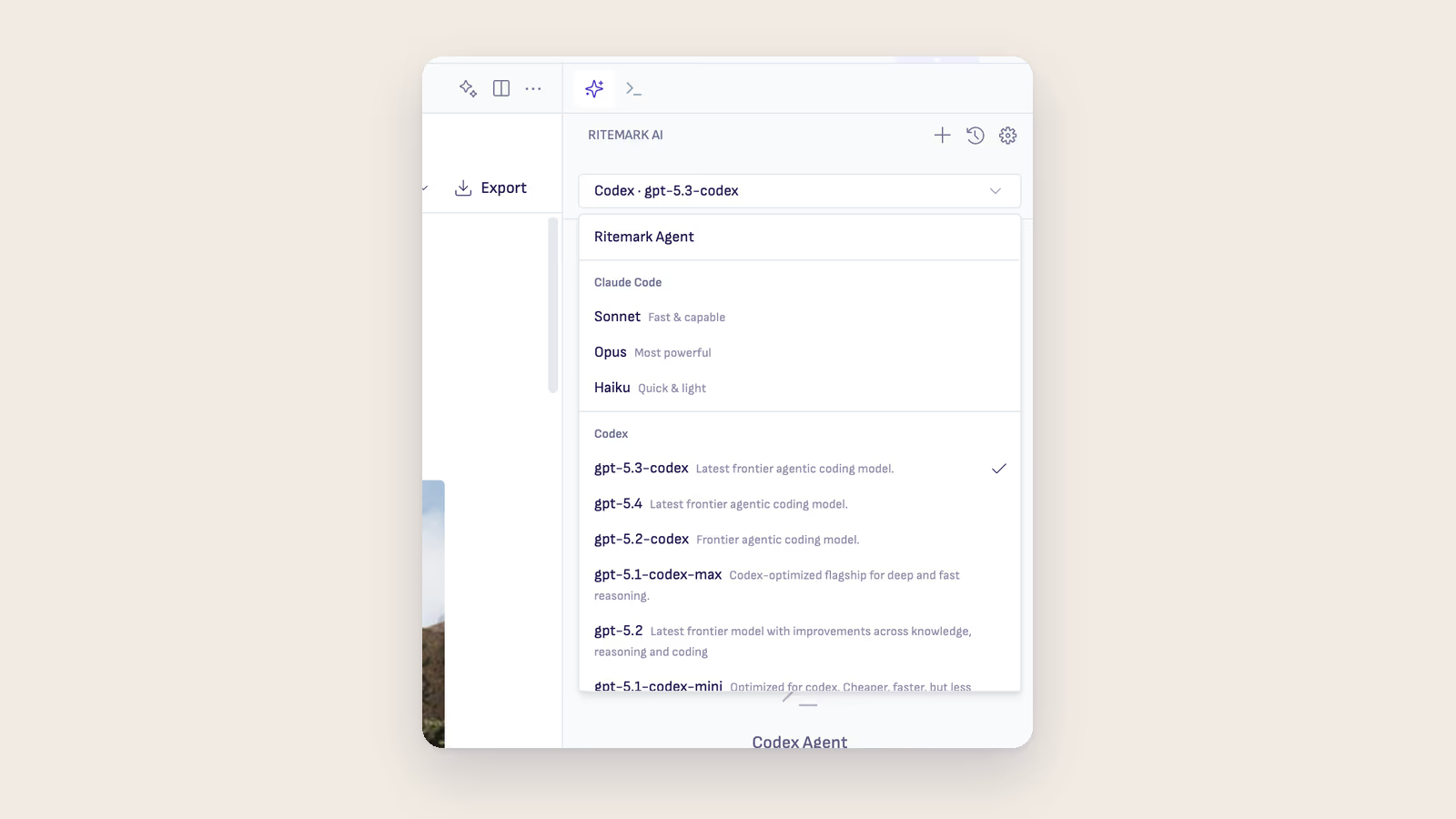
That matters because agents are changing fast. Ritemark already supports a multi-agent direction: Claude Code, Codex and OpenCode (with your own API keys) run in the same sidebar, and you can switch between them. The point is not to bet your whole workspace on one of them. The point is to make switching possible when the task, price, limit, or model quality changes.
Ritemark does not remove provider limits. No app can make another company's compute unlimited.
What it can do is reduce workflow lock-in. If one agent is the wrong fit today, the work should not be trapped with it.
A practical checklist for agentic resilience
If you are starting to depend on AI agents, ask these questions:
- Where does the work actually live: in files, or inside a vendor chat history?
- Can another agent read the same project without rebuilding the whole context manually?
- Can you keep writing or coding if today's preferred model hits a limit?
- Are long-running tasks visible and reviewable, or hidden inside a black-box conversation?
- Do your documents remain useful without the agent that helped create them?
- Can you choose the agent by task instead of by habit?
If the answer is no, you do not just have a tooling preference. You have a workflow dependency.
The durable layer should be yours
Provider limits will keep changing. Prices will keep changing. Models will leapfrog each other. Apps will add and remove product boundaries. That is normal for a market where compute is scarce and demand is exploding.
The stable layer should be your workspace.
Your files. Your notes. Your browser context. Your drafts. Your decisions. Your project history.
Agents should plug into that layer. They should not replace it.
That is the future Ritemark is building toward: an AI writing workspace where Claude, Codex, Gemini, and whatever comes next can help you do the work — without making your workflow dependent on any single one of them.
Try Ritemark if you want the document to stay yours and the agent to remain a choice.