Agentic knowledge management is an approach where AI agents autonomously organize, link, retrieve, and surface your knowledge — without you manually filing, tagging, or searching. Unlike traditional PKM tools where you manage the system, here the AI manages it for you. A concrete example: while you write, the agent reads your notes folder, finds a document you wrote six months ago on the same topic, and surfaces it automatically. According to IDC research, knowledge workers already waste 9.3 hours per week just searching for things they already have — agentic KM is built to eliminate that entirely.
That definition matters because it signals something most productivity tools have gotten backwards for years.
The Problem With "Second Brains"
You've probably heard the pitch before. Build a second brain. Use Obsidian. Set up a Zettelkasten. Create your own personal knowledge management system. Spend a weekend linking your notes, tagging your ideas, building the perfect vault that will finally make you productive.
You try it for three weeks. Then life gets busy. You stop filing. The vault goes stale. You end up back where you started — brilliant ideas living in browser tabs, half-finished thoughts scattered across notebooks and apps, the same research you did six months ago somehow impossible to find today.
This isn't a discipline problem. It's a design problem.
The entire premise of personal knowledge management as practiced today is that you do the organizing. You write the note, you assign the tag, you create the link to the related concept, you revisit and maintain the system. You become the archivist of your own mind. And most of us simply don't have the time, focus, or desire to do that consistently.
The traditional PKMS approach — Obsidian, Notion, Roam Research — asks you to solve this problem by being more disciplined. Agentic knowledge management asks a different question entirely: what if the AI just handled it?
What "Agentic" Actually Changes
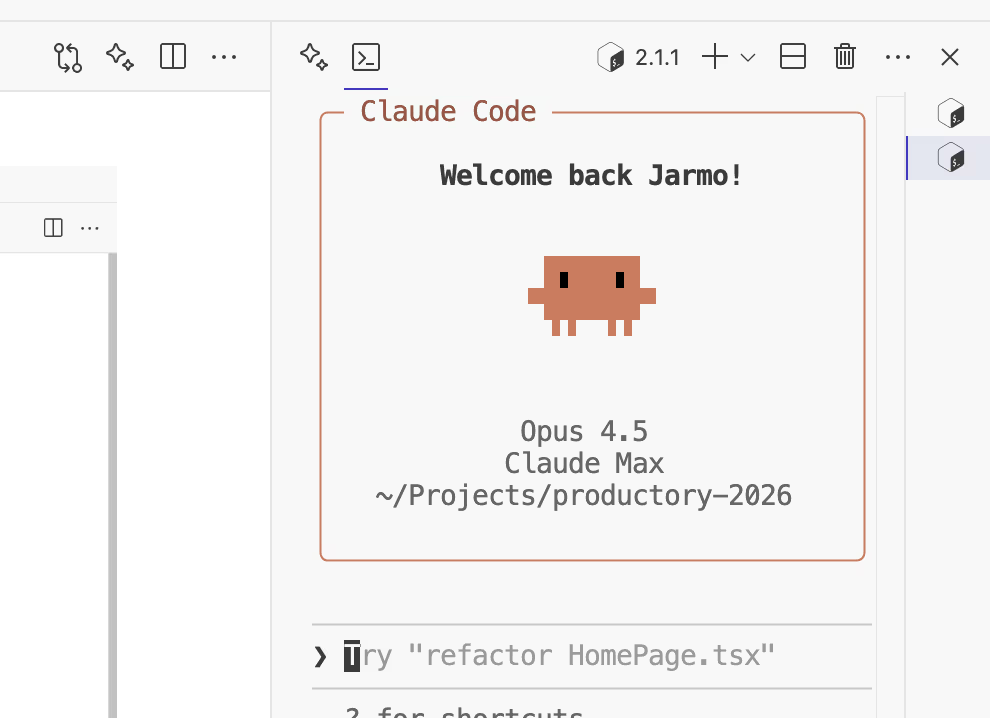 Ritemark's built-in terminal: where your AI agent actually lives alongside your writing.
The word "agentic" is doing a lot of work right now in tech circles, so it's worth being precise. An AI agent isn't just a chatbot that answers questions. It's a system that can take actions — read files, write files, create links, run searches, execute tasks — without you manually driving every step.
In the context of knowledge management, this distinction is everything. A traditional AI assistant can help you write a summary if you paste text into it. An AI agent can read your entire notes folder, identify which documents are related to what you're currently writing, surface the relevant ones automatically, and update your index while you focus on the actual thinking.
That's the shift Sébastien Dubois identified clearly on dsebastien.net: agentic KM means moving from a model where you manage your knowledge system to one where your AI manages it for you, proactively, as part of your natural workflow. You stop being the librarian. You become the reader.
McKinsey recognized this shift in their comprehensive analysis of where AI agents create the most business value. Knowledge management ranked in the top two business functions where AI agents deliver measurable ROI — directly alongside customer engagement. The reason isn't surprising: knowledge work is fundamentally about moving information from where it lives to where it's needed, and that's exactly what agents are built to do.
The Market Is Sending a Signal
The numbers tell a clear story about where the industry is heading. The AI knowledge management market reached $7.71 billion in 2024, growing at 47.2% year-over-year. That's not incremental growth — it's a category being reinvented.
Gartner projects that by 2026, enterprises that have deployed AI systems in their knowledge workflows will outperform competitors by 25% on key productivity metrics. The gap between organizations that have shifted to agentic approaches and those still relying on manual knowledge management is going to widen fast.
And yet most individual knowledge workers — the people building personal vaults, writing in Obsidian, trying to maintain their Zettelkasten — are still doing everything by hand. The enterprise tools exist, but they're built for IT departments with six-figure budgets, not for a solo researcher or a freelance writer trying to think clearly.
This is the gap that agentic approaches in personal tools are beginning to fill.
Why Traditional Tools Hit a Wall
Let's be honest about what Obsidian and Notion are actually good at.
Obsidian is an excellent tool for browsing your notes. The graph view is genuinely beautiful. The plugin ecosystem is remarkable. If you have the time and interest to maintain a well-organized vault, it rewards that investment. The problem is that maintaining a well-organized vault is itself a significant ongoing job.
Notion is an excellent tool for collaborative knowledge — shared wikis, project documentation, team pages. It's built for the assumption that multiple people will contribute and maintain the system together.
Both are fundamentally built around you as the active agent. You create the structure. You assign the tags. You build the links. The software is a sophisticated container; you're the one putting things in it thoughtfully.
What neither tool provides — and what's genuinely new — is an AI that sits inside your file system with direct read/write access and can act on your behalf without you explicitly telling it what to do every time. Obsidian's AI plugins route your text through external APIs. They don't have persistent access to your vault structure. They can't proactively reorganize while you work. For a deeper look at how today's PKM tools compare on this dimension, the differences are significant.
What Agentic KM Looks Like in a Real Workflow
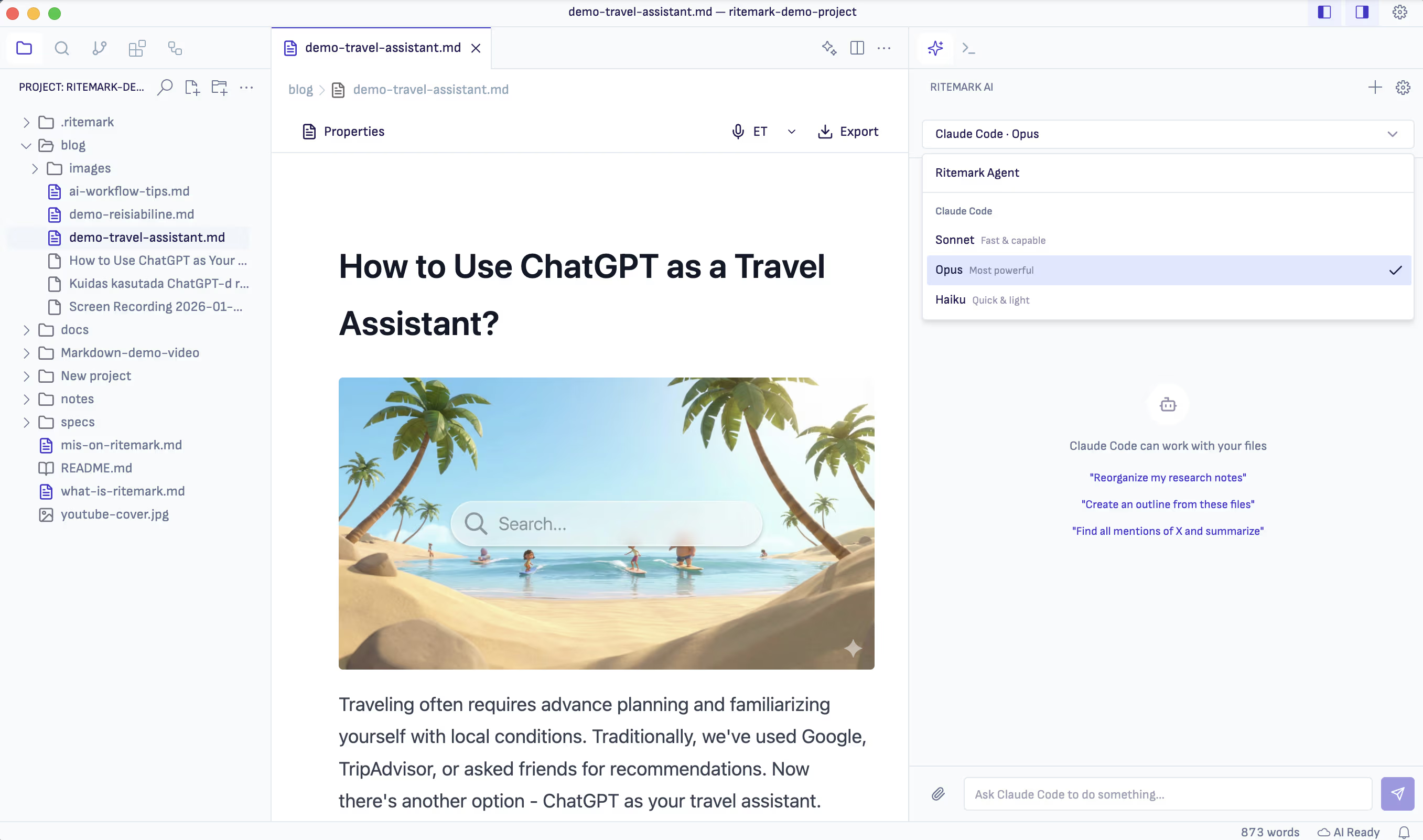 The agent sidebar in Ritemark: AI that sees your files, not just what you paste into it.
Here's what a genuinely agentic knowledge workflow looks like when the pieces are in place.
You're writing a document about a new project. Your AI agent, running in the background, notices that you're discussing a topic you've written about before — maybe six months ago in a different context. It surfaces that old note automatically, without you having to search for it. You read it, realize there's relevant context you'd forgotten, and incorporate it.
Later, you ask the agent to help you find everything you've written about a particular client. It reads across your entire file structure, pulls together documents from three different folders you'd half-forgotten, and gives you a coherent summary. In five seconds. Not the 45 minutes it would have taken manually.
When you finish a document, the agent can suggest tags, propose links to related content in your vault, and even create a brief summary that gets added to an index file — so future-you can find it without reconstructing the context from scratch.
This isn't theoretical. Ritemark's built-in terminal supports this kind of workflow today, with one difference: the agent works when you ask it to, not by watching what you type. Because the terminal runs inside your writing environment and has direct access to your local file system, an AI agent like Claude Code can read, write, and reorganize your notes folder while you stay focused on writing. There's no API layer filtering what the agent can see. No copy-paste bottleneck limiting what context it has. Direct file access means genuinely agentic behavior.
💡 Why local file access matters: Cloud-based tools keep your notes on their own servers. A local agent with direct file system access can work with your entire knowledge base — including files you never explicitly shared — and can take action without requiring you to manually select and copy text each time.
The Privacy Layer That Changes Everything
There's a dimension to agentic knowledge management that doesn't get discussed enough: what happens to your knowledge when the AI processes it.
Most enterprise knowledge management tools — Guru, Notion AI, Confluence AI — work by sending your content to cloud APIs, where it gets processed on someone else's infrastructure. For public content, that's a reasonable tradeoff. For personal research notes, confidential client information, competitive strategy documents, or just the raw half-formed thinking you do before you're ready to share anything — it's a significant concern.
A local-first agentic approach, where the agent works in your own environment and your files stay plain files on your machine, changes the calculus entirely. You get the full benefit of an AI agent that understands your entire knowledge base, without uploading your notes to yet another cloud service. What the agent reads still goes to the AI provider you chose, so you decide which folders it may open.
This is one of the reasons Ritemark's terminal-based approach resonates with writers, researchers, and consultants who work with sensitive material. The agent has access to your files because it's running on your machine, not because you've uploaded them somewhere.
The Shift in Mental Model
The hardest part of adopting an agentic approach isn't technical. It's psychological.
For years, productivity culture has told us that the discipline of managing our own notes is itself valuable — that the act of reviewing, linking, and maintaining your knowledge system is how ideas get reinforced and synthesized. Tiago Forte built a business around this idea. The Zettelkasten community is passionate about it. And there's real truth there: the act of consciously working with your own ideas does deepen understanding.
But there's also a survivorship bias in that narrative. The people who thrive with elaborate manual knowledge management systems are, almost by definition, the people who enjoy that kind of meticulous organization. For everyone else — the majority of knowledge workers who have interesting ideas but limited administrative patience — the discipline-first approach produces vaults that work beautifully for two weeks and then rot.
Agentic KM doesn't eliminate your role in sense-making. You still decide what's worth writing down, what conclusions matter, what connections are meaningful. You still do the actual thinking. What the agent eliminates is the filing. And for most people, that's the part that was killing the system anyway. If you want to understand what a well-designed second brain with AI agents actually looks like in practice, the architecture is simpler than most people expect.
Getting Started Without Rebuilding Everything
If you're already using a markdown-based knowledge system — whether in Obsidian, in plain folders, or directly in Ritemark — the transition to agentic approaches is simpler than it sounds.
The key is getting an AI agent that has persistent, direct access to your file system. Not a plugin that routes selected text through an API. An actual agent that can open, read, write, and organize files in your notes folder without you manually feeding it content each time.
In Ritemark, this is what the built-in terminal enables. You open a Claude Code session directly alongside your document, and the agent can see everything in your project folder. You can ask it to find related notes, suggest links, create summaries, reorganize files — and it can do all of that because it has real file system access, not just access to whatever you've pasted into a chat window.
Start small. Open your notes folder in Ritemark. Start a Claude Code session in the terminal. Ask it to read your recent notes and identify any recurring themes you might not have noticed. See what it finds. The first time the agent surfaces a connection you'd genuinely forgotten, you'll understand why this approach is different.
Ready to Let the AI Do the Filing?
Download Ritemark and try running a Claude Code session against your notes folder. Ask it what you've been thinking about. You might be surprised what you've already written.
Download Ritemark for macOS — it's free.
FAQ
What is agentic knowledge management? AI agents autonomously organize, link, and surface your knowledge without manual filing or tagging. Unlike traditional PKM — where you manage the system — in agentic KM the AI manages it for you.
How is agentic KM different from AI in Obsidian or Notion? Obsidian and Notion plugins only see text you paste into them. An agentic approach gives the AI persistent, direct access to your file system so it can act proactively without manual input.
How much time do knowledge workers waste searching for information? Approximately 9.3 hours per week, according to IDC research. That's more than a full workday every week spent on retrieval rather than productive work.
Is agentic KM only for large enterprises? No. Any tool that gives an AI agent direct, persistent access to your local file system enables agentic KM at a personal scale. Enterprise budget is not required.
Does agentic KM replace Obsidian or Notion? Not necessarily. Both remain strong for manual browsing and collaboration. Agentic KM adds an AI layer that actively manages and surfaces content rather than waiting for you to navigate to it.
What makes Ritemark suitable for agentic knowledge management? Ritemark's built-in terminal gives an AI agent like Claude Code genuine file system access to your notes folder — not just what you paste into a chat window. The agent can read, write, and reorganize files while you write.
Is my data safe with an agentic KM approach in Ritemark? Your notes stay plain files on your machine, and Ritemark has no cloud for them. Whatever the agent reads goes to the AI provider you chose, under your own account and its terms, so decide which folders you open with it.
How do I start with agentic knowledge management today? Open your notes folder in Ritemark, start a Claude Code session in the built-in terminal, and ask it to identify recurring themes across your recent notes. The agent works across your actual files immediately.
What is a PKMS? PKMS stands for Personal Knowledge Management System — tools like Obsidian, Notion, or Roam Research used to capture and retrieve your own knowledge. Traditional PKMS requires manual upkeep; agentic PKMS delegates that to AI.
How big is the AI knowledge management market? The market reached $7.71 billion in 2024, growing at 47.2% year-over-year. Gartner projects enterprises using AI-powered knowledge systems will outperform competitors by 25% by 2026.